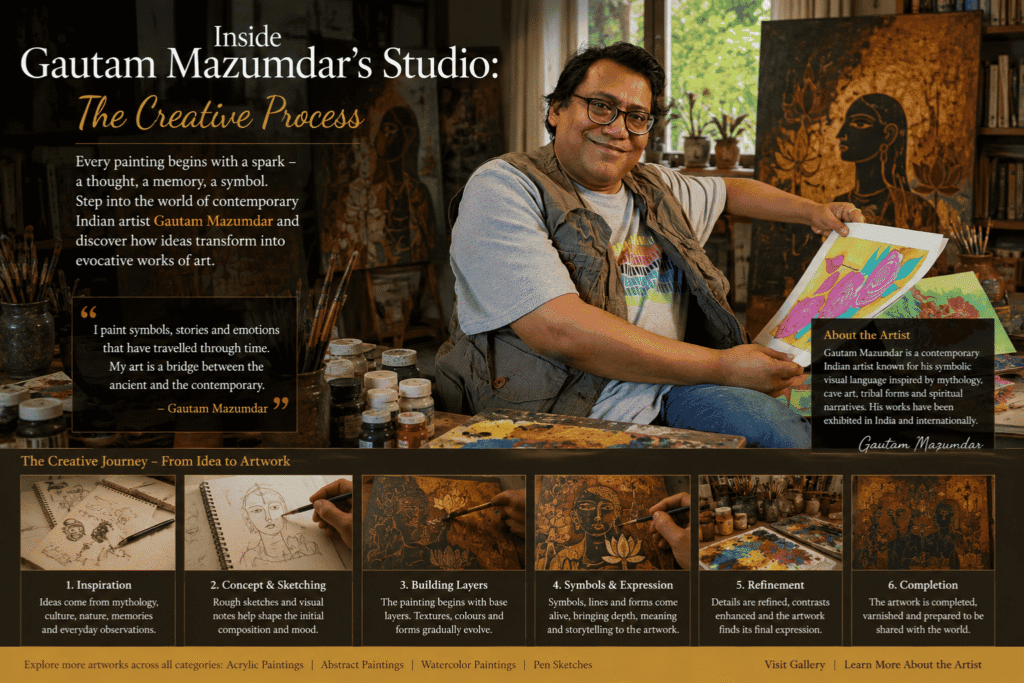
Every artwork begins long before paint touches the canvas. Behind every finished painting lies a deeply personal journey of observation, experimentation, emotion, and imagination. For contemporary Indian artist Gautam Mazumdar, the studio is not simply a workspace — it is a place of exploration where symbolism, mythology, memory, and artistic intuition come together to form visual narratives.
The creative process inside an artist’s studio is often invisible to viewers. Audiences usually experience only the completed artwork displayed in galleries or exhibitions. However, the journey behind art creation is filled with sketches, layered textures, evolving ideas, failed experiments, emotional reflection, and spontaneous discoveries.
Inside Gautam Mazumdar’s studio, contemporary art becomes a dialogue between ancient symbolism and modern expression. The studio environment itself reflects the artist’s fascination with mythology, tribal imagery, spiritual forms, abstract compositions, and cultural storytelling.
In this behind-the-scenes article, we explore the artistic process, inspirations, materials, and philosophy that shape the artworks created inside Gautam Mazumdar’s studio.
The Studio as a Creative Space
For many artists, the studio becomes an extension of the mind. It is a place where thoughts evolve visually and creative energy transforms into physical form.
Inside Gautam Mazumdar’s studio, unfinished canvases, sketches, pigments, brushes, handmade papers, and textured surfaces coexist as part of an ongoing creative process.
The studio atmosphere encourages:
- experimentation
- observation
- layering
- reflection
- emotional exploration
Unlike structured office environments, an artist studio thrives on creative unpredictability. New ideas often emerge spontaneously during the painting process itself.
Inspiration Behind the Artworks
Artistic inspiration rarely comes from a single source. Gautam Mazumdar’s work draws from multiple influences including:
- mythology
- cave art
- tribal symbolism
- spirituality
- urban experiences
- ancient civilizations
- music and memory
These inspirations merge to create artworks that feel both historically rooted and visually contemporary.
Many paintings evolve gradually through emotional and symbolic associations rather than fixed conceptual plans.
The Influence of Ancient Symbolism
One of the most distinctive elements within Gautam Mazumdar’s art creation process is the use of symbolic imagery.
The studio often contains visual references connected to:
- Egyptian mythology
- sacred geometry
- tribal forms
- lotus symbolism
- cave paintings
- spiritual motifs
Rather than copying historical imagery directly, these references are reinterpreted through contemporary abstraction and textured compositions.
This process creates artworks that bridge ancient visual culture with modern artistic expression.
Learn more about the artist here:
About
Beginning the Creative Process
Every artwork begins differently. Some paintings start with rough sketches, while others emerge directly through spontaneous mark-making on the surface.
Concept Development
The initial stage often involves:
- observing visual references
- exploring symbolic ideas
- emotional reflection
- experimenting with composition
At this point, the artwork remains fluid and open to transformation.
Surface Selection
The choice of surface plays an important role in the final visual language.
Gautam Mazumdar frequently works on:
- canvas
- handmade paper
- textured paper
- stone slate
- mixed-media surfaces
Different surfaces influence:
- paint absorption
- texture
- layering possibilities
- emotional atmosphere
Materials Used in the Studio
Art materials are not simply technical tools; they shape the emotional and visual character of the artwork itself.
Acrylic Paints
Acrylics are widely used because they allow:
- strong textures
- vibrant color
- fast layering
- experimental techniques
Explore acrylic artworks here:
Acrylic Paintings
Watercolor and Ink
Watercolor and pen techniques often appear in sketch-based works and urban studies.
These mediums create:
- fluidity
- transparency
- movement
- delicate linework
Explore watercolor artworks here:
Watercolor Paintings
Pen and Mixed Media
Pen sketches and symbolic linework help build visual rhythm and narrative structure within many compositions.
Explore pen sketch collections here:
Pen Sketches (B&W)
Texture and Layering in Art Creation
Texture is one of the most important aspects of Gautam Mazumdar’s artistic language.
The creative process often involves:
- scraping
- layering
- palette knife work
- dry brush techniques
- mixed media integration
These textures create:
- visual depth
- emotional intensity
- symbolic complexity
Layering also reflects the conceptual idea that memory, culture, and human experience are built gradually over time.
All categories
The Role of Color in the Studio Process
Colors are carefully chosen not only for visual harmony but also for emotional and symbolic meaning.
Earth Tones and Primitive Energy
Brown, ochre, black, and rust tones often appear in cave-inspired artworks, creating connections to ancient rock surfaces and prehistoric visual culture.
Vibrant Contemporary Contrasts
Bright reds, blues, golds, and purples introduce modern energy into symbolic compositions.
This contrast between earthy textures and vivid contemporary color palettes creates a unique visual identity.
How Artworks Evolve During Creation
Many artworks change dramatically during the painting process.
Initial sketches may disappear entirely beneath layered textures and symbolic forms.
Unexpected visual discoveries often emerge through:
- accidental textures
- spontaneous brushstrokes
- color interactions
- intuitive decision-making
This openness is an essential part of the creative process.
Rather than controlling every detail from the beginning, the artwork develops organically over time.
Music, Silence, and Atmosphere in the Studio
The atmosphere inside the artist studio significantly affects creativity.
Sometimes the process unfolds in complete silence.
At other times, music influences rhythm, movement, and emotional tone.
Music often helps create:
- meditative focus
- emotional flow
- visual rhythm
This relationship between sound and visual art becomes especially important during abstract and symbolic compositions.
The Emotional Side of Art Creation
Art creation is not purely technical. It often involves emotional vulnerability and introspection.
Some artworks emerge from:
- memory
- personal experiences
- spiritual reflection
- cultural identity
- emotional tension
The studio becomes a space where emotions are translated visually rather than verbally.
Many contemporary artists describe painting as both a creative and meditative process.
The Importance of Experimentation
Experimentation is central to Gautam Mazumdar’s studio practice.
The artist frequently explores:
- new materials
- unusual surfaces
- symbolic reinterpretation
- mixed-media combinations
Not every experiment succeeds immediately, but creative risk-taking often leads to unexpected artistic breakthroughs.
This willingness to experiment keeps the work evolving continuously.
Preparing Artworks for Exhibitions
Once artworks are completed, the studio process continues through:
- documentation
- framing
- curation
- exhibition planning
Collections are carefully organized around themes such as:
- symbolism
- mythology
- cave art
- lotus imagery
- cultural narratives
Exhibitions transform individual artworks into larger visual conversations.
Explore the gallery here:
Gallery
How Exhibitions Influence Future Artworks
Exhibitions often inspire new creative directions.
Audience reactions, collector conversations, and gallery experiences help shape future artistic exploration.
Series such as:
- Cave to Canvas
- Kamal Khila Hai
- Arabian Allure
reflect evolving themes within the artist’s studio practice.
Exhibition experiences frequently lead to:
- expanded symbolism
- larger compositions
- deeper conceptual narratives
The Relationship Between Artist and Viewer
Although the creative process begins privately inside the studio, the artwork ultimately enters public space through exhibitions and collections.
Once viewers engage with the painting, new meanings emerge beyond the artist’s original intention.
This dialogue between artist and audience becomes an essential part of contemporary art.
Why Behind-the-Scenes Studio Practice Matters
Collectors and viewers increasingly appreciate understanding the creative process behind artworks.
Studio insights reveal:
- artistic authenticity
- craftsmanship
- conceptual depth
- emotional intention
This transparency creates stronger connections between artist, artwork, and audience.
It transforms paintings from decorative objects into meaningful cultural expressions.
Final Thoughts on the Creative Process
Inside Gautam Mazumdar’s studio, art creation becomes a continuous exploration of symbolism, texture, emotion, and cultural memory.
The creative process is rarely linear. It evolves through experimentation, intuition, reflection, and layered visual storytelling. Every artwork carries traces of the studio environment in which it was created — from unfinished sketches and accidental textures to symbolic discoveries and emotional atmosphere.
For viewers and collectors, understanding the journey behind the artwork adds deeper appreciation to the final piece.
Ultimately, the studio is more than a physical space. It is where imagination, memory, culture, and artistic vision come together to create contemporary art that connects past traditions with present expression.
Connect Now: Facebook | Instagram | Twitter | Threads | Linkedin | Pinterest