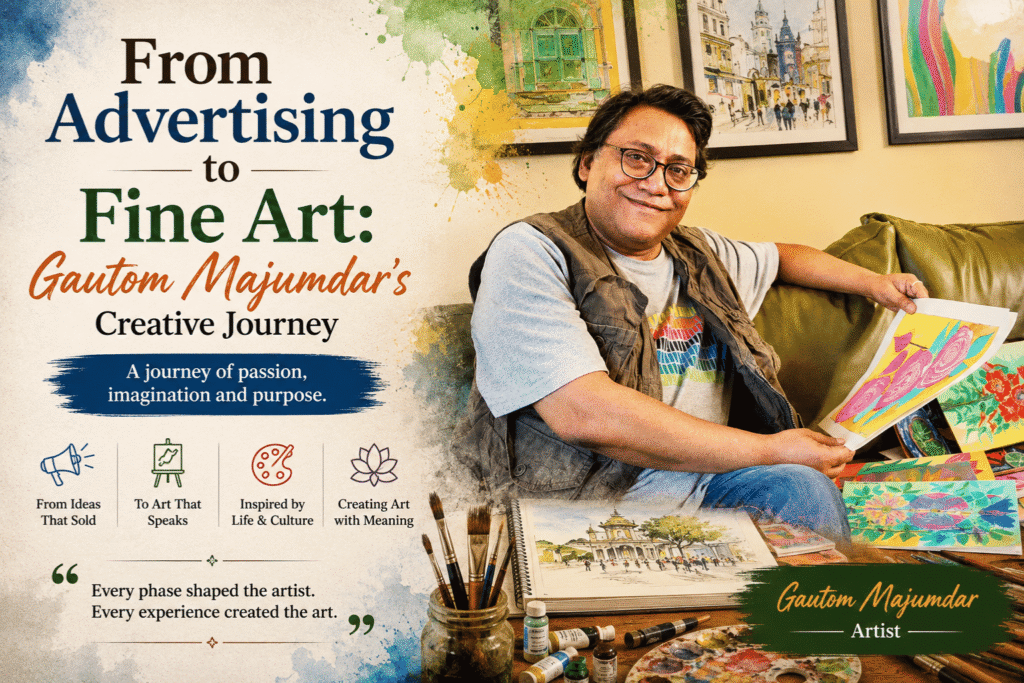
Every artist’s journey is shaped by experience, experimentation, and the gradual evolution of creative identity. For contemporary Indian artist Gautam Mazumdar, the path toward fine art did not begin inside galleries or traditional art institutions alone. Instead, it emerged through years of visual communication, design thinking, and creative exploration within the world of advertising before transforming into a deeply personal artistic practice rooted in symbolism, abstraction, and cultural storytelling.
The transition from advertising to fine art is not simply a career shift. It is a movement from commercial communication toward emotional and philosophical expression. While advertising focuses on delivering clear visual messages within limited timeframes, fine art allows unrestricted exploration of memory, symbolism, spirituality, culture, and imagination.
Today, Gautam Mazumdar’s artworks reflect a unique fusion of design discipline and artistic freedom. His paintings combine structured composition with expressive textures, mythology, cave art influences, abstract symbolism, and contemporary visual experimentation.
This article explores Gautam Mazumdar’s creative journey — from the world of advertising and commercial design to becoming a contemporary artist whose work bridges tradition, symbolism, and modern artistic expression.
Early Creative Influences
Like many artists, Gautam Mazumdar’s connection with visual creativity began long before professional recognition.
Early exposure to:
- drawing
- storytelling
- color
- visual observation
- cultural imagery
helped shape an instinctive relationship with art and design.
Indian visual culture itself became an important influence. Traditional motifs, mythology, folk art, spiritual symbolism, and urban environments all contributed to the artist’s evolving creative sensibility.
Even before entering the professional world, there was a natural attraction toward visual experimentation and expressive imagery.
Entering the World of Advertising
Advertising introduced Gautam Mazumdar to the discipline of visual communication.
In the advertising industry, creativity must function within:
- strategy
- audience psychology
- design structure
- storytelling clarity
- brand identity
This environment helped develop important artistic skills such as:
- composition
- color balance
- conceptual thinking
- visual impact
- attention to detail
Unlike fine art, advertising requires immediate communication. Every image, shape, and layout must serve a specific purpose.
This professional experience later became a strong foundation for artistic development.
How Advertising Influenced Artistic Vision
The years spent in advertising significantly influenced Gautam Mazumdar’s approach to contemporary art.
Understanding Visual Storytelling
Advertising sharpened the ability to communicate emotion and narrative visually.
This skill later evolved into symbolic storytelling within paintings.
Many contemporary artworks now contain:
- layered symbolism
- visual rhythm
- conceptual narratives
- emotional tension
without relying on literal realism.
Strong Composition and Design Awareness
The structured discipline of commercial design continues to appear in:
- balanced compositions
- controlled movement
- visual hierarchy
- color harmony
Even abstract works often carry underlying design precision.
Experimentation with Materials and Surfaces
Commercial creative environments often encourage innovation and adaptability.
This openness later influenced experimentation with:
- acrylic textures
- handmade paper
- mixed media
- stone slate surfaces
- symbolic abstraction
The Transition from Commercial Art to Fine Art
The movement toward fine art developed gradually rather than suddenly.
Over time, there emerged a desire for:
- deeper personal expression
- creative independence
- philosophical exploration
- emotional authenticity
Fine art offered the freedom to move beyond client requirements and explore themes connected to:
- mythology
- spirituality
- symbolism
- memory
- cultural identity
This transition allowed the artwork to become more introspective and emotionally layered.
Discovering Symbolism and Cultural Narratives
One of the defining characteristics of Gautam Mazumdar’s artistic journey is the exploration of symbolic imagery.
The artworks increasingly began incorporating:
- lotus symbolism
- tribal forms
- cave art references
- Egyptian mythology
- sacred geometry
- abstract spiritual motifs
Rather than reproducing historical imagery literally, these symbols are reinterpreted through contemporary artistic language.
This creates paintings that feel:
- ancient yet modern
- symbolic yet abstract
- personal yet universal
The Influence of Cave Art and Ancient Civilizations
Ancient visual cultures became an important source of inspiration within the creative process.
Cave paintings, tribal imagery, and early human storytelling traditions inspired works that explore:
- primitive visual language
- symbolic memory
- cultural continuity
- human imagination
This fascination eventually evolved into exhibitions such as:
- Cave to Canvas
- symbolic abstraction series
- mythology-inspired collections
These artworks reflect the idea that visual storytelling has connected humanity across civilizations for thousands of years.
Explore exhibitions here:
Exhibitions
Building a Contemporary Artistic Identity
The transition into fine art also required developing a distinct visual identity.
Over time, Gautam Mazumdar’s work became recognized for:
- textured surfaces
- symbolic compositions
- bold acrylic contrasts
- spiritual undertones
- cultural references
This evolving artistic language allowed the work to move beyond decorative aesthetics into conceptual storytelling.
The paintings increasingly became reflections of:
- memory
- philosophy
- spirituality
- emotional exploration
The Role of Acrylic Painting in the Creative Journey
Acrylic painting became an important medium because of its flexibility and expressive potential.
Acrylics allowed experimentation with:
- texture layering
- palette knife techniques
- mixed media
- vibrant contrasts
- symbolic abstraction
The medium’s adaptability suited the artist’s evolving visual language.
Explore acrylic collections here:
Acrylic Paintings
Watercolor, Sketches, and Spontaneous Expression
Alongside acrylic works, watercolor and pen sketches remain essential parts of the creative process.
These mediums provide:
- spontaneity
- fluidity
- observational freedom
- intimate artistic expression
Sketching often becomes the foundation for larger conceptual works.
Urban observations, symbolic forms, and emotional studies frequently begin as smaller sketch-based explorations.
Exhibitions and Public Recognition
As the artistic journey evolved, exhibitions became important milestones in expanding public visibility.
Exhibitions such as:
helped introduce the artwork to broader audiences, collectors, and international viewers.
These exhibitions allowed the work to exist not only as individual paintings but also as larger thematic conversations.
Gallery environments transformed personal studio exploration into shared cultural experiences.
View the gallery here:
Gallery
The Importance of Creative Independence
One of the greatest differences between advertising and fine art is creative independence.
In commercial design:
- communication goals are predefined
- audience expectations guide visual decisions
- deadlines shape creativity
In fine art:
- intuition becomes central
- experimentation remains open
- emotional authenticity matters deeply
This independence allows artworks to evolve naturally without strict external limitations.
Art as a Reflection of Personal Evolution
The creative journey from advertising to fine art also reflects personal transformation.
As artistic practice matured, the paintings increasingly explored:
- inner reflection
- symbolism
- spirituality
- cultural memory
- emotional complexity
Art became less about visual perfection and more about meaningful expression.
This evolution continues through ongoing experimentation and exploration.
Contemporary Indian Art and Global Visibility
The rise of digital platforms and international exhibitions has expanded the visibility of contemporary Indian artists significantly.
Today, artists can connect directly with:
- global collectors
- galleries
- exhibitions
- online audiences
This visibility allows contemporary Indian art to participate in broader global artistic conversations while preserving cultural authenticity.
Learn more about the artist here:
About
Why Gautam Mazumdar’s Journey Resonates
Many contemporary artists and creative professionals relate to journeys that evolve across disciplines.
The movement from advertising to fine art reflects:
- the search for authentic expression
- the desire for creative freedom
- the transformation of visual language over time
It demonstrates how commercial creative experience can eventually evolve into deeply personal artistic practice.
Rather than abandoning design principles, Gautam Mazumdar integrated them into a contemporary fine art approach rooted in symbolism and cultural exploration.
The Relationship Between Discipline and Creativity
One important lesson from this creative journey is that discipline and experimentation can coexist.
Advertising provided:
- technical precision
- compositional structure
- visual clarity
Fine art introduced:
- emotional exploration
- symbolic freedom
- conceptual depth
Together, these experiences shaped a unique artistic identity balancing design intelligence with expressive spontaneity.
Final Thoughts on Gautam Mazumdar’s Creative Journey
The journey from advertising to fine art reflects more than a professional transition. It represents the evolution of creative identity itself.
Through years of visual communication experience, experimentation with materials, symbolic exploration, and artistic introspection, Gautam Mazumdar developed a contemporary artistic language that bridges ancient cultural references with modern expression.
Today, his work continues to explore mythology, abstraction, spirituality, texture, and visual storytelling while remaining deeply connected to both personal and cultural memory.
For viewers and collectors, this creative journey offers insight into how artistic expression evolves over time — shaped by experience, discipline, imagination, and the continuous search for meaning through art.
Connect Now: Facebook | Instagram | Twitter | Threads | Linkedin | Pinterest